
Congress’s Quagmire, Causes A

CAUSES: Non-Proportional Voting, Safe Seats, Others Not Rooted in Electoral Laws

NON-PROPORTIONAL VOTING
Proportional voting means that the results of an election are as proportional to the desires of the voters in that election as practicable. The information below shows that non-proportional voting can be quite unfair. California just voted to permit further gerrymandering that may create more imbalance (see below). Gerrymandering is one type of electoral law. Of course, similar unfair electoral laws exist in many other states and often favor the other party. Even if they were to balance nationally – which is unlikely – that is no consolation to the disenfranchised voters around the country. This and following Substack posts will provide more detail for electoral methods that create non-proportional voting – and low turnout.

Democrats hold 83% of the CA House seats with 45% of the registered voters. Republicans hold 17% of the CA House seats with 25% of the registered voters. No-Party folks hold 0% of the CA House seats with 22% of the registered voters.
A tool very useful in providing much better proportionality in elections with more than two candidates it Ranked Choice Voting (RCV), now often called Instant Runoff Voting (IRV). Tune in onto the Jan 5 post to see how this tool can be used effectively to prevent the non-proportionality and unfairness of primaries.
OpenPrimaries.org reported that November 2025 Gallup polling indicates that 47% of Americans now identify as Independents. This must be larger than either of our parties X and Y. So, non-proportional and other unfair electoral (voting) laws are competition-restrictive and limit voters almost completely to parties X and Y, funneling voters to one of two choices like a cattle chute.

Some Causes of Non-Proportional Outcomes
Gerrymandering
First past-the-post voting in primaries and/or general elections. Often, the winner does not have to have a majority of those who voted to win.
Primaries and general elections governed by restrictive electoral laws that make it extremely difficult for a candidate not from one of our two powerful parties to be successful.
Low turnout - voters stay home because they are confident their favorite candidate does not have a chance due to the electoral laws in place.
SAFE SEATS
Reference: The Guardian.org, Sam Levine in New York, Feb. 17, 2022
What is a safe seat? Wikipedia defines it as fully secure…for a certain party, incumbent, or both. FiveThirtyEight defines it as having at least a 5% election advantage.
We all know that the number of safe seats in the US House is exacerbated by gerrymandering, or according to Merriam-Webster, “the practice of dividing or arranging a territorial unit into election districts in a way that gives one political party an unfair advantage in elections.” Safe Seats are also fostered by other intentionally unfair electoral methods that will be explored later. Dave Wasserman of the non-partisan Cook Political Report as of February 2022 estimated that as many as 94% of representatives will be in relatively safe seats.
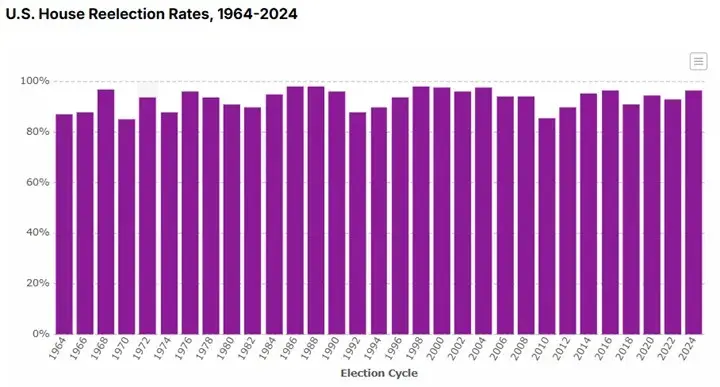
The general election winner of a safe seat almost always will be determined by the party holding that seat at the time of the election. This means that the important discourse in campaigns is intraparty, taking place within the closed and/or partisan primaries of each party. And, with safe seats, we almost always know which of those parties is going to win in the general election. This further means that there is reduced campaigning between the two parties, fewer points of view being aired, and more adoption of the party line in the safe districts, giving voters only one choice. No wonder we have polarization! No wonder voter turnout is so poor!
Some causes of Safe Seats (same as under Proportional Voting above)
Gerrymandering
First past-the-post voting in primaries and/or general elections. Often, the winner does not have to have a majority of those who voted to win.
Primaries and general elections governed by restrictive electoral laws make it extremely difficult for a candidate not from one of our two powerful parties to be successful.
Low turnout - voters stay home because they are confident their favorite candidate does not have a chance due to the electoral laws in place.
OTHERS NOT ROOTED IN ELECTORAL LAWS
Electoral laws established generally at the state level by one or the other of the two dominating parties are causes of most of Congress’s Quagmire. However, it is useful to list a few other causes.
It is easy for the reader to conclude that we the people have permitted a culture to evolve that is more appealing to politicians who place high value on remaining in a powerful and prestigious position than to persons enthusiastic to resolve our country’s pressing problems.
Big money in politics
No term limits
Very generous retirement and other benefits
Ability to lobby Congress after serving as a member
Seating by party. We have all seen TV scenes of seating by party in both the House and Senate and the extreme partisanship. This is most obvious in a joint session of Congress where we can see one side of the room standing and clapping and the other side sitting on its hands. We also have heard of members that have never met many members of the opposing party. The book Reviving Our Republic by Mike Bedenbaugh suggests that the present seating arrangement in Congress may exacerbate the partisanship that it is dysfunctional to Congress’s problem solving. Decades ago, when it was impractical to travel home frequently, members formed friendships across party lines outside working hours, furthering collaboration. Now, each chamber could easily and quickly institute monthly random reseating without regard to political party, something that would promote dialogue across party lines and collaboration.


Comments